The increasingly obvious shift toward authoritarianism is discussed on almost every news program. The dilemma is discussed from innumerable perspectives and consumes a large portion of these programs. The descriptions and theories on the problem are also numerous and varied as everyone appears to be searching for the solution. The chart below certainly confirms that Public Trust in Government has been steadily declining since the 1960’s and is currently at all-time lows.
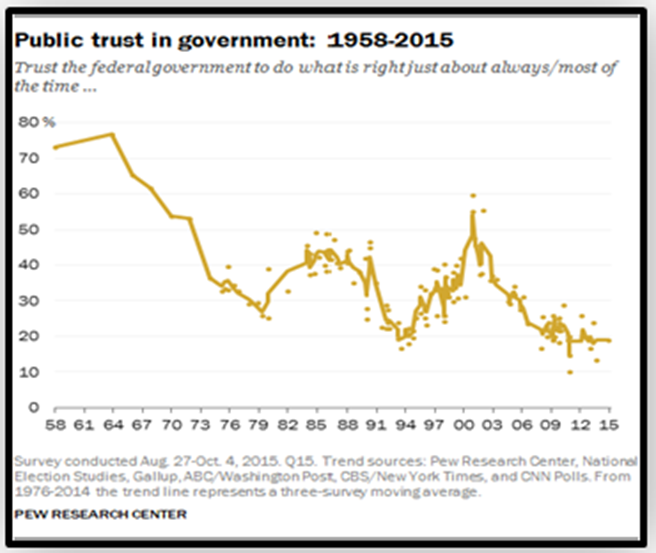
A saying attributed often to Albert Einstein perhaps explains the reason this multitude of experts cannot identify the solution:
“In order to find the solution to a problem one must first identify the cause.”
This cause eludes discovery simply because these experts and authorities are looking in the wrong place. They confine their perspective to politics when the root cause is elsewhere.
Even in face of attempts to explain it, by the groups identified later in this article, It still evades detection because of a well-known psychological factor known as cognitive dissonance. When informed about what is causing this dilemma, most people dismiss the explanation out of hand.
A small group has identified the cause of this problem and has been attempting to inform the public for many years. The principle is well understood by the general public, and they accept it as causal in many aspects of life. So, let’s start off by explaining this idea in an area where most would understand and agree with this cause, effect and solution scenario.
Decision-making, when many people have a stake in the outcome, has a direct link to the concept of democracy. Group dynamics is the study of how individuals behave and interact within a group setting. We are going to focus on how decisions are made within a group setting when they utilize a voting method to discern the ‘Will of the People.’ This is typically understood to mean the ‘Will of the Majority’ of people in the group.
Most people understand it is a bit more complicated than just taking a vote.
- In an open voting system, individuals vote in a manner that exposes their vote to others. In this situation, voting your conscience may have other consequences.
- In a secret ballot voting system, individuals vote in a manner that hides their vote from others. In this situation, voting your conscience does not have other consequences.
So how do these aspects lead us to the cause that is moving us toward authoritarianism?
Open Ballot Voting:
Voting in an open ballot system means that the individual’s vote is visible to others or recorded for all to see. It could be a show of hands, yeas and nays, ballots that include the I.D. of the voter, votes that have a record available, etc.
The voter is faced with the following considerations:
- Is my vote the best decision on the issue?
- Could there be any other consequences to how I vote from:
- My friends, my enemies, my boss, my relatives, those opposed to my choice, affected individuals, organizations or groups, would someone pay me to vote their way, etc.
Secret Ballot Voting:
Voting in a secret ballot system means that the individual’s vote is unknown to anyone other than the voter and even the voter cannot prove how they voted.
The voter is faced with the following considerations:
- Is my vote the best decision on the issue?
Historically, open ballot formats have often developed forms of coercion, corruption, threats, rewards, other influencing factors that are negative in allowing the voter the ability to ‘vote their conscience.’
| Legal Questions: Are there examples where laws prohibit the use of an open ballot system to make decisions? Yes—many jurisdictions explicitly prohibit open ballot systems for official elections to protect voter privacy and prevent coercion. These laws typically mandate secret ballots for democratic integrity. Here are some notable examples: United States The Australian ballot system, adopted widely across U.S. states in the late 19th century, mandates secret voting in government elections.Most states have laws that prohibit open ballots in public elections to prevent voter intimidation and vote buying. Canada Canada Elections Act requires that federal elections use secret paper ballots, hand-counted to ensure transparency and voter privacy.Voters are prohibited from photographing their marked ballots, reinforcing the secrecy of the vote.Electronic or online voting is not permitted federally without prior approval from both the Senate and House of Commons, due to concerns about privacy and security. United Kingdom The Ballot Act of 1872 introduced the secret ballot for parliamentary and municipal elections, making open voting illegal in those contexts.This law was a response to widespread coercion and bribery under open voting systems. Why Secret Ballots Are Legally Required Prevent coercion or retaliation: Open ballots can expose voters to pressure from employers, political groups, or family.Ensure free expression: Voters are more likely to vote honestly when their choices are private.Maintain democratic integrity: Secret ballots are a cornerstone of fair elections. This page has used AI assistance to generate examples for reference. |
| Other Areas: Many countries—including the United States and Canada—have laws that require secret ballots in union elections, especially during certification and decertification processes. These laws are designed to protect workers from coercion and ensure democratic integrity. United States: National Labor Relations Act (NLRA) The NLRA mandates secret ballot elections supervised by the National Labor Relations Board (NLRB) when employees vote on union representation.Workers vote anonymously in a booth or via mail, ensuring privacy and freedom from intimidation.However, there’s ongoing debate over the “card check” system, where unions can be certified if a majority of workers sign authorization cards. Critics argue this method lacks the protections of a secret ballot. Canada: Canada Labour Code and Provincial Laws In 2015, Canada amended the Canada Labour Code to require mandatory secret ballot votes for union certification and decertification in federally regulated sectors (e.g., banking, broadcasting, transportation).Some provinces, like British Columbia, also require secret ballots for union certification. Others may allow card-based certification if a certain percentage of workers sign union cards.The Trudeau government introduced Bill C-4 to remove the mandatory secret ballot requirement, sparking controversy. The Senate later amended the bill to retain secret ballots, emphasizing their importance for worker autonomy. Why Secret Ballots Matter Protects voter anonymity: Workers can vote without fear of retaliation.Reduces coercion: Prevents pressure from union organizers, employers, or peers.Ensures legitimacy: Secret ballots are widely seen as the gold standard for democratic decision-making. This page has used AI assistance to generate examples for reference. |
These are examples where the general public understands and agrees with the benefits of the secret ballot process in its avoidance of coercion, corruption, fear of retaliation and numerous problems related to the open ballot process.
Given this broad understanding of the benefits of secret ballot and the problems of the open ballot process:
- How does this lead us to the cause that is pushing us toward authoritarianism?
- How does this lead us to the elusive solution that everyone seems to be missing?
- How can we stop this movement, return to democracy and save the Great Experiment?
There are two small, non-profit organizations that have recognized the effects, found the cause, and identified the solution. They have attempted to publicize these findings for almost three decades to media, influencers, academics, politicians and organizations.
These efforts have received little to no response from any of those that have the resources and reach to elicit public attention and consideration of the concept/solution.
A summary of their efforts and linked references is listed below:
The Association to Improve Government:
- Articles, Letters to Editors, Influencers, New Media personalities, politicians, etc. span the last three decades.
- Establishment of a website to solicit public support, outline the mission, establish a blog and offer free membership to those seeking a solution to develop a movement.
- A YouTube, (Change Your World) presentation to simplify the concept to the public
- Published a fictional, mystery trilogy “Freedom Flaw” to highlight the concept.
The Congressional Research Institute:
- Established a website.
- Created a YouTube video entitled ‘The Cardboard Box Reform’ to demonstrate the scientific process that uncovered the cause in the US and demonstrate the solution.
- Advertised a full page in a major US newspaper to highlight the concept.
The Cause: The Congressional Reorganization Act of 1970 (Two particular elements)
- It opened all Committee meetings to the public and eliminated protection that allowed congressmen to discuss, negotiate and compromise in private to arrive at rational legislative without coercion from special interest groups, lobbyists, powerful individuals and organizations.
- It established an absolute open ballot system that assured coercion, corruption and retribution. It effectively legalized bribery in the form of campaign contributions, loss of job/position via party actions, public threats, and many other forms of pressure.
- The concept of ‘Transparency’ was the motivation and the perceived cure for the turmoil and public unrest of the 1960’s. In this case, the cure was much worse than the perceived illness.
The Effects: A continual and inevitable movement toward authoritarianism.
- We have seen this continual movement since 1970, and it may now be at the point where there is little chance of avoiding an authoritarian outcome.
The Solution:
- Return Committee meetings to closed sessions.
- Keep the lobbyists in the lobby!
- Allow our representatives to represent us.
- Require all voting in Congress to conform to a rigorous secret ballot process.
“The possibility of improving the political system has little chance
of success until our Representatives are given the same freedom
and protection that we demand for ourselves.”
The Freedom to vote their conscience and protection from threats/coercion for doing so.
What a dilemma! Secret voting as identified in this article will do and produce the stated outcome!! The TRANSPARENCY in voting has gone too far and as stated in the article, produce the POSSIBILITY of casted votes that are rendered for the wrong reasons!
We vote for individuals that we believe serve our interests, whatever they may be! If we cast a vote for our beliefs then we do not want that individual INFLUENCED to vote in an alternate direction, PERIOD. Yes, circumstances can change but I believe the time is right for secret ballots!